
Micro Precision
Choosing the right Hydraulic Block in 2026 is no longer a simple catalog exercise. A compact manifold must manage pressure, flow, heat, contamination, and service access. Grand View Research estimates the global hydraulic equipment market reached approximately USD 49.4 billion in 2023, with continued growth expected through 2030. However, market size does not guarantee component quality.
Hydraulic engineer and author Anthony Esposito wrote, “A hydraulic system is a combination of components that transmit power by using a pressurized liquid.” His definition remains practical. The block is where several critical components meet. A poor internal passage can create pressure loss, turbulence, noise, or unwanted heat. A well-designed block can reduce hose length, leakage points, and assembly time.
Look closely at the application. Record operating pressure, peak pressure, flow rate, fluid type, temperature, and duty cycle. Then compare steel, aluminum, and stainless-steel options. ISO 4413 provides widely recognized safety principles for hydraulic fluid power systems, while the NFPA U.S. Fluid Power Industry Report highlights the importance of reliability, maintenance, and supply-chain performance.
Small details matter. Port orientation matters. So does access for a wrench.
That sounds tidy. Real installations are not.
A block rated for maximum pressure may still fail through incorrect machining, contamination, or poor sealing. Supplier traceability, tested drawings, material certificates, and documented pressure testing deserve serious attention. The right Hydraulic Block is not always the smallest or cheapest choice. It is the one that remains predictable when the machine is hot, dirty, heavily loaded, and difficult to repair. Forecasts can guide decisions, but the final choice still needs engineering judgment and field evidence.
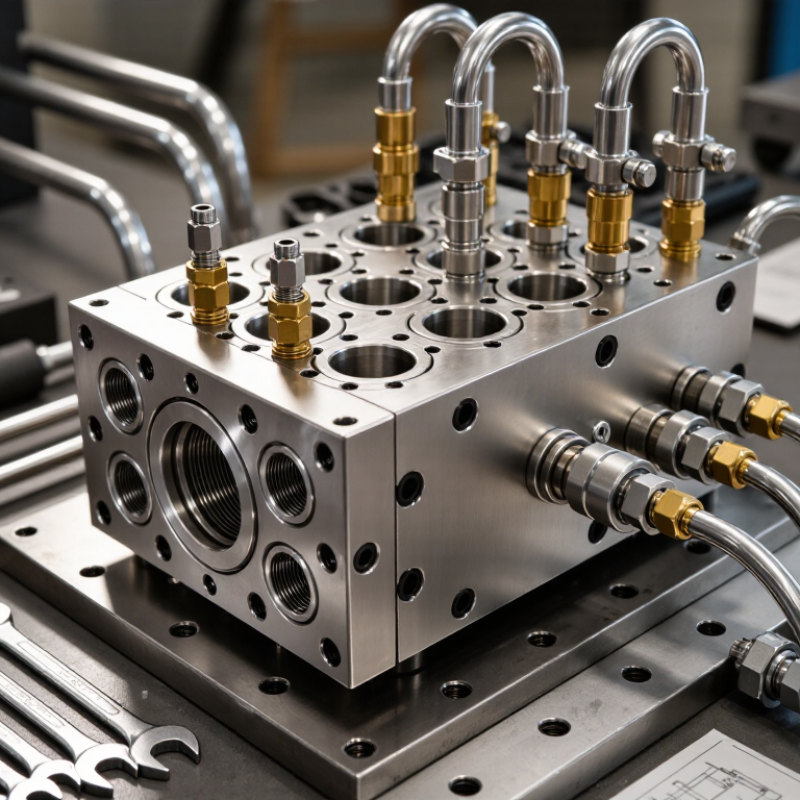
How to Choose the Right Hydraulic Block in 2026?
Define the Hydraulic Block’s Role in Your System
A hydraulic block is not merely a compact junction for hoses. It controls flow, pressure, sequencing, and maintenance access inside the circuit. Define its job before selecting materials, ports, or valve positions. A lifting system may need load holding and pressure relief. A clamping circuit may require precise flow control and rapid response. These duties demand different internal passages.
Use operating data, not guesswork. Record peak pressure, continuous pressure, flow rate, fluid temperature, and contamination levels. The 2024 Global Hydraulic Equipment Market report by Fortune Business Insights projects market growth from about 44.5 billion dollars in 2024 to 62.2 billion dollars by 2032. This expansion reflects increasingly integrated and demanding systems. Smaller blocks now carry more functions, leaving less tolerance for poor sizing.
Check every pressure drop across the block. Even a small restriction can create heat and slower actuator movement. ISO 4413 emphasizes safe design, pressure limitation, and controlled energy release in hydraulic systems. Apply those principles during layout reviews, not after assembly. In field work, I have seen beautifully machined blocks fail because service ports were inaccessible. That mistake is easy to repeat. Leave room for gauges, testing, cleaning, and future changes. A perfect block rarely exists. Recheck the circuit with real load data, because laboratory assumptions can mislead.
Match the block to your circuit, not the other way around. A compact manifold suits machines with several repeated functions and limited installation space. A monoblock valve body works well in simpler circuits with fixed flow paths. Modular sandwich blocks offer easier maintenance when pressure-control or directional functions may change later. For high-response motion, cartridge or proportional blocks can provide finer control, but they demand cleaner oil and tighter commissioning.
Start with operating pressure, peak flow, actuator sequence, and available ports. A block rated for 250 bar may fail early if pressure spikes exceed that figure. Leave practical margin.
The 2024 MarketsandMarkets Hydraulic Equipment report estimates the sector will grow from about USD 44.6 billion in 2024 to USD 55.3 billion by 2029.
That growth increases selection pressure, but market growth does not guarantee a suitable circuit design. The 2023 Global Industrial Hydraulic Systems report by Research and Markets also identifies energy efficiency and system reliability as major purchasing factors.
Use ISO 4413 safety principles when reviewing pressure relief, hose routing, isolation, and maintenance access. Measure real flow at operating temperature, not only catalogue values.
I have seen oversized blocks create unnecessary pressure loss and heat. It looked safer on paper. It was not.
Check port sizes, contamination tolerance, seal compatibility, and future expansion before approval. A slightly larger block may simplify service, while an undersized passage can quietly reduce actuator speed. Test the assembled circuit under cold and hot conditions. Real machines rarely behave perfectly.
Choosing a hydraulic block in 2026 starts with pressure, flow, and port compatibility. A compact manifold may look efficient, but its internal passages can restrict oil movement. Check the working pressure, peak pressure, and pressure losses separately. ISO 4413 recommends designing hydraulic systems with suitable safety margins, not simply matching the pump’s maximum rating.
Flow needs practical measurement. Use the circuit’s continuous flow and short-term peak flow, then verify the block’s rated capacity. The 2024 Allied Market Research report valued the global hydraulic equipment market at about USD 44.1 billion in 2022, showing the scale of equipment demand and the importance of reliable sizing. Still, market growth does not prove a component will suit your machine. Field experience matters more than a catalog headline.
Port compatibility is often underestimated. Confirm thread standard, nominal size, sealing method, and port orientation before ordering. A one-millimeter mismatch can create leakage, rework, or difficult hose routing. The ISO 6149 and ISO 1179 standards provide useful references for common hydraulic connections, but local drawings must control the final decision. Measure twice. Assemble once.
Do not ignore temperature, fluid viscosity, contamination, or installation space. These factors can change pressure loss and seal performance. I have seen technically correct selections fail because a return port was too small. That is an uncomfortable lesson. A pressure gauge near the block, flow data from the actual cycle, and a documented port check provide stronger evidence than assumptions. A small prototype test is usually cheaper than correcting a full installation.
| Hydraulic Block Type | Typical Working Pressure | Recommended Flow Range | Common Port Sizes | Port and Thread Compatibility | Typical Material | Suitable Applications | Selection Priority |
|---|---|---|---|---|---|---|---|
| Compact Control Block | Up to 210 bar | Up to 25 L/min | G1/4, G3/8, 1/4 in, 3/8 in | Choose the exact thread standard; do not mix BSPP, NPT, and metric threads without suitable adapters. | Anodized aluminum or zinc-plated steel | Small hydraulic power units, light clamping systems, compact actuators | Low weight and compact size |
| General-Purpose Manifold | Up to 250 bar | 10–50 L/min | G3/8, G1/2, 3/8 in, 1/2 in | Verify port thread, sealing method, valve cavity, and mounting pattern before installation. | Steel or high-strength aluminum | Industrial machinery, material handling, presses, and mobile equipment | Balanced pressure and flow capacity |
| High-Pressure Control Block | Up to 315 bar | 20–80 L/min | G1/2, G3/4, 1/2 in, 3/4 in | Use pressure-rated fittings and confirm that the block, valves, seals, and tubing share the same pressure class. | Machined carbon steel | High-force cylinders, injection machinery, heavy-duty presses | Pressure rating and fatigue resistance |
| High-Flow Manifold | Up to 250–315 bar | 50–120 L/min | G3/4, G1, 3/4 in, 1 in | Port diameter and internal passages must support the required flow without excessive pressure drop. | Steel, often with a corrosion-resistant surface treatment | Large cylinders, hydraulic power units, mobile machinery, rapid actuator circuits | Flow capacity and pressure-loss control |
| Modular Valve Interface Block | Up to 315 bar | Up to 80 L/min | Interface ports plus G1/4 to G3/4 service ports | Match the valve interface standard, mounting dimensions, O-ring locations, cavity form, and port numbering. | Precision-machined steel or aluminum | Directional, pressure, and flow-control valve assemblies | Interface and mounting compatibility |
| Cartridge Valve Block | Up to 350 bar | Up to 150 L/min | G1/2, G3/4, G1, SAE-style ports | The cartridge cavity, shoulder diameter, seal arrangement, and valve function must match the selected cartridge. | Machined steel | Compact high-performance circuits, load holding, counterbalance, and motion control | Cavity accuracy and leakage control |
| Test and Diagnostic Block | Up to 420 bar | Low flow; commonly for measurement and isolation | Test ports, G1/4, M14×1.5, M16×1.5 | Check test-coupling size, pressure rating, gauge connection, and measurement-point accessibility. | Steel or stainless steel | Pressure measurement, troubleshooting, maintenance, and commissioning | Safe access and measurement accuracy |
| Corrosion-Resistant Block | Typically up to 250–315 bar | 10–80 L/min | Metric, BSPP, SAE, or NPT options depending on the circuit | Confirm thread standard, seal material, environmental exposure, and compatibility with the hydraulic fluid. | Stainless steel or specially treated steel | Marine equipment, outdoor machinery, washdown areas, and humid environments | Material durability and sealing compatibility |
Reference values are typical engineering ranges rather than universal limits. The final selection should be based on the maximum continuous pressure, peak pressure, actual flow rate, allowable pressure drop, hydraulic-fluid compatibility, port thread standard, valve interface, temperature, and applicable safety requirements.
How to Choose the Right Hydraulic Block in 2026?
Select Materials, Seals, and Control Features
Material selection begins with the working environment. Carbon steel suits many standard systems and handles high pressure well. Stainless steel helps resist moisture, salt, and aggressive cleaning chemicals. Aluminum reduces weight but may need careful pressure and thread evaluation. In field service, corrosion often appears around fittings first. Small details matter. Check fluid compatibility, operating temperature, vibration, and maintenance access before approving the block.
Seals require equal attention. Nitrile seals perform reliably with many petroleum-based fluids and moderate temperatures. Fluorocarbon compounds tolerate higher heat and several demanding fluids. Polyurethane can resist abrasion, but it may not suit every chemical mixture. Never choose a seal from pressure data alone. Review the fluid safety sheet and confirm the actual temperature range. Laboratory data helps, yet real equipment can behave differently.
Control features should match the operator’s needs, not marketing trends. Pressure sensors can reveal unstable cycles before damage occurs. Proportional control improves adjustment when flow must change smoothly. Manual overrides remain valuable during power loss or troubleshooting. Add diagnostic ports where technicians can measure pressure without dismantling the circuit. I have seen compact blocks become difficult to repair because access was ignored. That mistake is easy to repeat. Check port layout, labeling, test records, and applicable pressure standards before installation.
Select the block material, seal compound, and control features according to pressure, temperature, fluid compatibility, and response requirements.
The chart shows commonly published typical continuous service-temperature ranges for widely used hydraulic seal materials. NBR is a practical general-purpose option for petroleum-based fluids, EPDM is preferred for water-based fluids, FKM supports higher temperatures and chemical resistance, and PTFE provides the widest temperature range with low friction. Actual limits depend on compound formulation, pressure, fluid, extrusion gap, and duty cycle. For the hydraulic block itself, select steel or ductile iron for higher mechanical loads, aluminum for weight reduction, and include proportional or servo control when precise flow or pressure regulation is required.
Choosing the right hydraulic block in 2026 requires more than matching port size. Safety must guide every specification. Confirm that the rated pressure exceeds the system’s maximum working pressure, including short pressure spikes. Check material compatibility with the fluid, seals, temperature range, and nearby components. A relief path should remain accessible, not hidden behind a panel. Ask for traceable test records and clear identification marks. They support sound decisions when conditions change.
Installation errors often appear as leaks, noise, or sudden heat. Clean every port before connection. Even a small metal chip can damage a valve seat. Use the specified thread type and tightening torque. Excessive force may distort the block. Support heavy tubing separately, because unsupported weight can stress the manifold. Mount it where technicians can isolate pressure and see the gauges. Leave room for a wrench and future seal replacement.
I once treated “fits” as “ready.” That assumption was wrong.
Long-term maintenance begins before commissioning. Record the block’s location, pressure setting, fluid type, and installation date. Inspect joints for wetness, cracked seals, abnormal vibration, and temperature changes during early operation. Set inspection intervals according to duty cycle, contamination risk, and technical data. Replace damaged seals with compatible parts, then retest at controlled pressure.
Keep an honest maintenance log. It reveals patterns that memory misses. Recheck the design after a pump, actuator, or fluid change. A block that worked well last year may need different protection today.
It directs flow, controls pressure, sequences actions, and provides service access. It is more than a hose junction.
Record continuous pressure, peak pressure, flow rate, fluid temperature, and contamination levels. Real measurements beat guesses.
Check working pressure, peak pressure, and pressure loss separately. Do not match the block only to the pump rating.
Undersized passages restrict oil movement, create heat, and slow actuators. Compare continuous and short-term peak flow with the block’s rated capacity.
Check thread type, nominal size, sealing method, and port direction. A tiny mismatch can cause leaks or difficult hose routing.
High temperature can weaken seals and change fluid behavior. Contamination may damage valves or restrict narrow passages.
Leave space for gauges, testing, cleaning, and future changes. An inaccessible service port can ruin an otherwise excellent installation.
No. Test pressure loss with actual cycle data and load conditions. A small prototype often reveals inconvenient problems early.
Choosing the right Hydraulic Block in 2026 starts with understanding its role within the complete hydraulic system. Determine whether it will manage flow distribution, pressure control, actuator operation, or a combination of functions. Then select a block type that matches the circuit design, including the required number of ports, valves, channels, and control points. Carefully compare working pressure, peak pressure, flow rate, fluid compatibility, and port standards to ensure reliable performance and prevent unnecessary restrictions or leakage.
Material and seal selection should reflect the operating temperature, hydraulic fluid, environmental exposure, and expected service life. Useful control features may include pressure relief, check, flow-control, or proportional functions, depending on system requirements. Before installation, verify safety requirements, connection orientation, access for inspection, and protection against contamination. A well-chosen Hydraulic Block should also support straightforward maintenance, spare-part replacement, testing, and future system adjustments, helping improve efficiency, reliability, and long-term operating stability.
